Published
- 5 min read
Window Strikes: How to Stop Finches from Hitting Your Glass
Window Strikes: How to Stop Finches from Hitting Your Glass
You’ve set up the perfect feeding station. It’s filled with fresh Nyjer seed, safely baffled against squirrels, and the Goldfinches are visiting daily. You’re enjoying your morning coffee, watching them from the kitchen, when suddenly you hear a sharp, sickening thud against the glass.
Window strikes are one of the leading causes of mortality for backyard birds, killing hundreds of millions of birds annually in North America alone. Small, fast-flying flock birds like American Goldfinches and Pine Siskins are particularly susceptible when they scatter in a panic to avoid a hunting hawk.
As a responsible backyard birder, attracting birds to your yard means you are also responsible for their safety. In this guide, I will explain why window strikes happen and provide you with the most effective, proven methods to make your windows “visible” to your feathered guests, featuring the best preventative products on Amazon.
1. Why Do Birds Hit Windows?
Birds do not understand the concept of glass. To them, a window is an invisible forcefield. They hit windows for two main reasons:
- The Reflection Illusion: During the day, the glass on your home acts like a mirror, reflecting the sky, the trees, and your garden. A finch flying at top speed sees a clear flight path into the trees (which are actually just reflections) and flies straight into the solid glass.
- The “See-Through” Effect: If you have two windows opposite each other in a room (e.g., a sunroom or a corner window), a bird might see through the first window, out the second window, and try to fly straight through the house as a shortcut.
2. The Golden Rule of Feeder Placement
The easiest way to prevent window strikes actually has nothing to do with the window itself; it has to do with where you place your finch feeder.
You must follow the 3-Foot or 30-Foot Rule.
- Closer than 3 feet: If your feeder is extremely close to the window (or mounted directly on it), a bird flying away from the feeder cannot build up enough speed to severely injure itself if it accidentally hits the glass.
- Further than 30 feet: If your feeder is more than 30 feet away, the bird is more likely to recognize the house as an obstacle and have enough time to alter its flight path.
- The Danger Zone: Placing a feeder between 5 and 15 feet from a window is a death trap. The bird has enough room to reach top speed, but not enough room to veer away if they get spooked by a predator and fly blindly toward the reflection of the trees.
3. The Best Window Treatments (How to Break the Reflection)
If you cannot move your feeders, you must treat your windows. Taping a single, black hawk silhouette to the center of a massive picture window does not work. Birds will simply try to fly around the hawk and still hit the glass.
You must break up the reflection across the entire surface of the window.
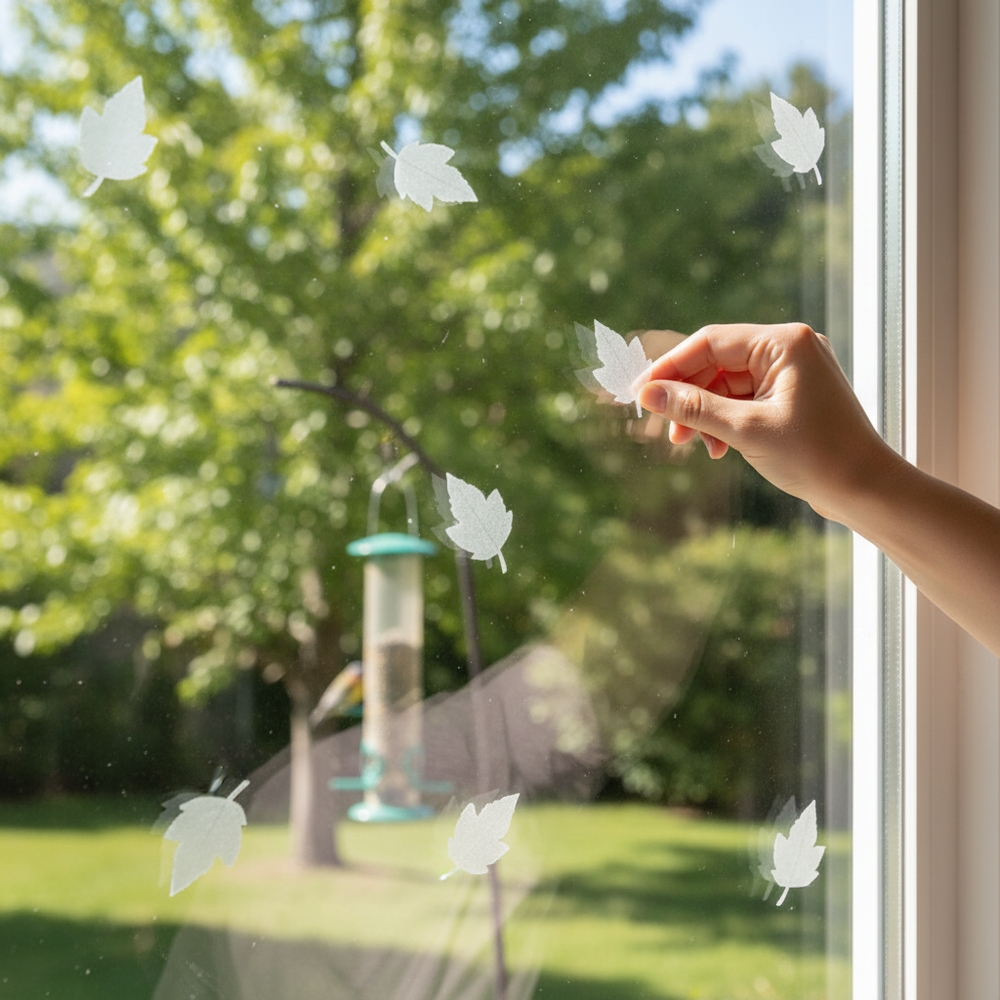
1. UV Window Decals (The Invisible Shield)
Birds can see ultraviolet light; humans cannot.
- How it works: These clear decals are coated with a special UV-reflective material. To you, they look like clear, frosted stickers. To a finch, they glow like bright blue stop signs.
- The Spacing: You must apply these decals generously. They should be spaced no more than 4 inches apart across the entire window (the “2x4 rule”).
- Affiliate Pick: WindowAlert UV Reflective Bird Decals (Leaf Medley)
2. The Zen Wind Curtain (Acopian BirdSavers)
This is widely considered the most effective physical barrier.
- How it works: These are closely spaced, hanging cords (usually dark paracord) that dangle down the outside of your window. They gently sway in the breeze. The physical barrier completely destroys the reflection of the trees and creates a highly visible obstacle.
- The Aesthetic: They look neat and orderly, much like a subtle, external bamboo blind.
- Affiliate Pick: Bird B Gone Window Strike Deterrent Cords
3. The DIY Solution: Tempera Paint or Soap
If you have a problem right now and need an immediate fix, grab a bar of soap or a bottle of washable tempera paint.
- How it works: Draw a dense, grid-like pattern of lines or dots on the outside of the glass. The lines must be no more than 2 inches apart vertically and 4 inches apart horizontally. It isn’t the most beautiful solution, but it will save lives until your Amazon order arrives.
Conclusion
Hearing the thud of a window strike is a heartbreaking experience that ruins the joy of backyard birding. By understanding the reflection illusion and taking proactive steps—whether it’s adjusting the distance of your feeder or applying high-quality UV decals from Amazon—you can ensure your home remains a safe, welcoming sanctuary for Goldfinches and all your feathered friends. Don’t wait for the first strike to happen; protect your windows today.