Published
- 5 min read
Beyond the Feeder: Essential Optics for Backyard Finch Watching
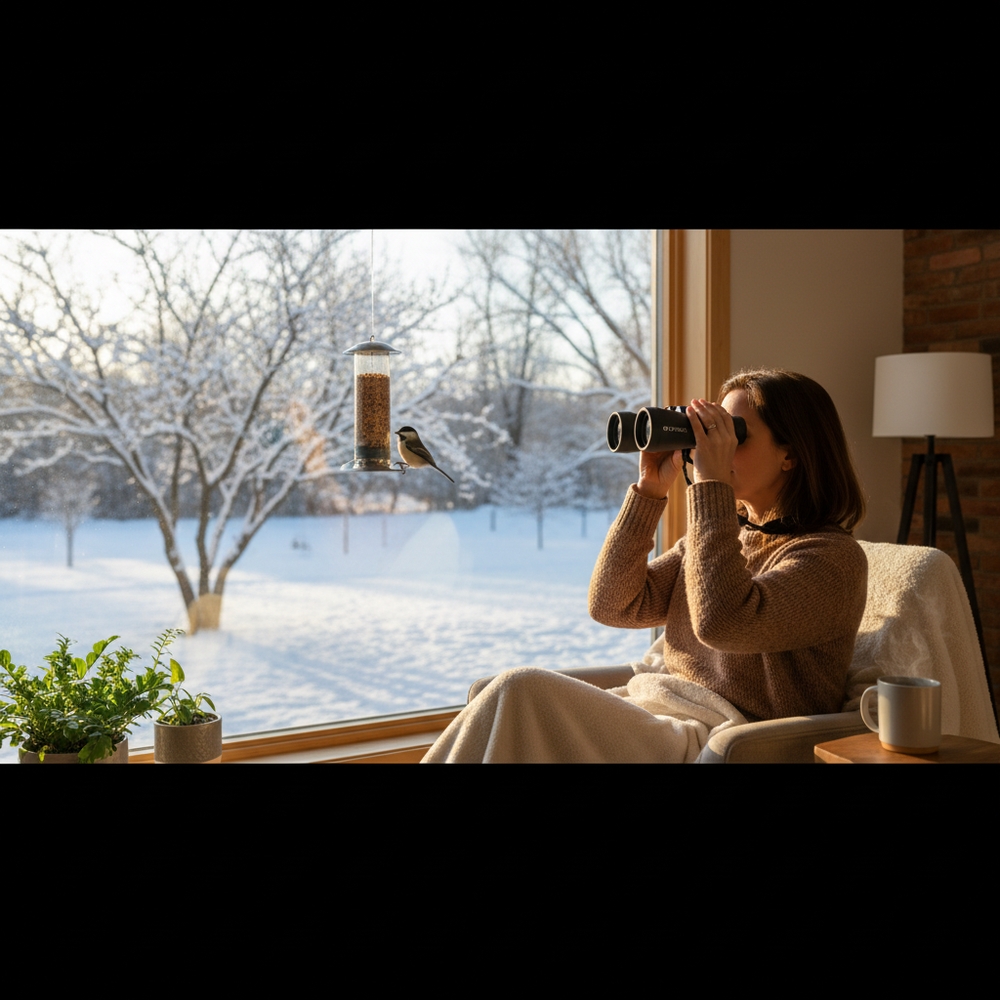
Beyond the Feeder: Essential Optics for Backyard Finch Watching
Setting up a thriving finch feeding station is only the first half of the backyard birding experience. The second half is actually watching the birds.
Finches are incredibly small and fast. An American Goldfinch is barely 5 inches long. When they are clustered around a Nyjer tube feeder 30 feet away from your kitchen window, or foraging high in the canopy of a sunflower stalk, observing them with the naked eye means missing out on the exquisite details of their plumage and their fascinating social interactions.
To truly appreciate the beauty of a male Goldfinch molting into his bright summer yellow, or the subtle red wash of a Purple Finch, you need to bring the birds closer. In 2026, you don’t need to spend thousands of dollars on professional, heavy camera lenses to do this. You simply need the right set of backyard optics.
In this guide, I will break down the exact optical specifications you need for watching small, fast birds, and review the best binoculars and spotting scopes available on Amazon for the backyard enthusiast.
1. The Binocular “Sweet Spot”: Why 8x42 is King
When shopping for binoculars, you will see two numbers (e.g., 10x50, 8x42, 8x25).
- The First Number (Magnification): This is how many times closer the object appears. The beginner’s mistake is buying the highest magnification possible (like 12x or 15x). Do not do this for backyard birding. High magnification drastically reduces your field of view, making it nearly impossible to find a fast-moving finch in the trees. It also amplifies the natural shake of your hands, resulting in a jittery, nauseating image. 8x magnification is the absolute sweet spot for stability and tracking.
- The Second Number (Objective Lens): This is the diameter (in millimeters) of the large front lenses. The larger the lens, the more light it gathers. A 42mm lens gathers enough light to make the colors of a finch pop, even in the deep shade of an evergreen tree on a cloudy winter day.
The Top Pick: Nikon ProStaff 3S 8x42
Nikon is a legendary name in optics, and the ProStaff line brings their high-end glass to a very accessible price point.
- Why it wins: It is exceptionally lightweight (under 20 ounces), meaning you can hold them up for long periods without your arms getting tired. The lenses are fully multi-coated with silver-alloy, providing a remarkably bright, color-accurate image.
- The Verdict: The absolute best entry-level premium binocular for backyard birders.
- Get it on Amazon: Nikon ProStaff 3S 8x42 Binoculars
2. The Step-Up: Upgrading to ED Glass
If you have a slightly higher budget and want an optical experience that rivals binoculars costing twice as much, you should look for “ED” (Extra-Low Dispersion) glass.
- The Benefit: ED glass corrects “chromatic aberration”—that annoying purple or green fringe of light you sometimes see around the edges of a high-contrast object (like a dark bird against a bright white sky). It provides razor-sharp, edge-to-edge clarity.
The Premium Choice: Vortex Optics Diamondback HD 8x42
Vortex is wildly popular in the hunting and birding communities due to their rugged build quality and unconditional lifetime warranty.
- Why it wins: The “HD” optical system delivers stunning resolution. They are fully waterproof and argon-purged, meaning the lenses will never fog up on the inside if you take them from a warm house out into the freezing winter snow to watch Pine Siskins.
- Get it on Amazon: Vortex Optics Diamondback HD 8x42
3. The Spotting Scope: For “Window Blind” Birding
If your primary birding location is sitting at your kitchen table looking out a large window at a feeder 50 feet away, a spotting scope might be a better investment than binoculars.
- The Advantage: A spotting scope is essentially a small telescope. It offers much higher magnification (usually 20x to 60x zoom). Because it must be mounted on a tripod, the image is perfectly stable.
- The Technique: You set up the scope and tripod inside your house, focus it perfectly on the Nyjer feeder, and lock it in place. Whenever a flock arrives, you just lean over and look through the eyepiece for a breathtaking, screen-filling view of the birds.
- Digiscoping: You can also buy a cheap adapter to attach your smartphone directly to the spotting scope eyepiece, allowing you to take incredible, highly-zoomed photos without an expensive camera.
The Best Backyard Scope: Gosky 20-60x80 Spotting Scope
- Why it wins: It offers variable zoom, allowing you to find the feeder at 20x and then zoom in to 60x for close-ups. The massive 80mm objective lens gathers incredible light. It also comes with a smartphone adapter and a tabletop tripod included.
- Get it on Amazon: Gosky 20-60x80 Spotting Scope with Smartphone Mount
Conclusion
You cannot truly appreciate the frantic energy, the social hierarchy, and the brilliant plumage of a finch flock with the naked eye. By investing in the right optical gear—whether it’s the versatile 8x42 binoculars for scanning the yard or a stable spotting scope for window watching—you elevate your backyard setup from a simple feeding station to a personal wildlife observatory.