Published
- 4 min read
How to Identify Goldfinches, House Finches, and Purple Finches
How to Identify Goldfinches, House Finches, and Purple Finches
Setting up a Nyjer seed feeder is an open invitation to some of the most active, musical, and colorful birds in North America. However, when a flock descends on your yard, identifying exactly who is dining at your buffet can be a challenge. They are all small, they all have conical beaks, and they move with frantic speed.
The three most common finches you will encounter in a North American backyard are the American Goldfinch, the House Finch, and the Purple Finch.
While the bright yellow male Goldfinch is unmistakable in the summer, telling a female Goldfinch apart from a female House Finch, or distinguishing a male House Finch from a male Purple Finch, requires a bit of expert knowledge. In this guide, I will break down the key visual markers and behavioral clues to help you identify your backyard visitors with confidence.
1. The American Goldfinch (The Summer Star)
The American Goldfinch is the poster child for Nyjer seed feeders.
The Breeding Male (Summer)
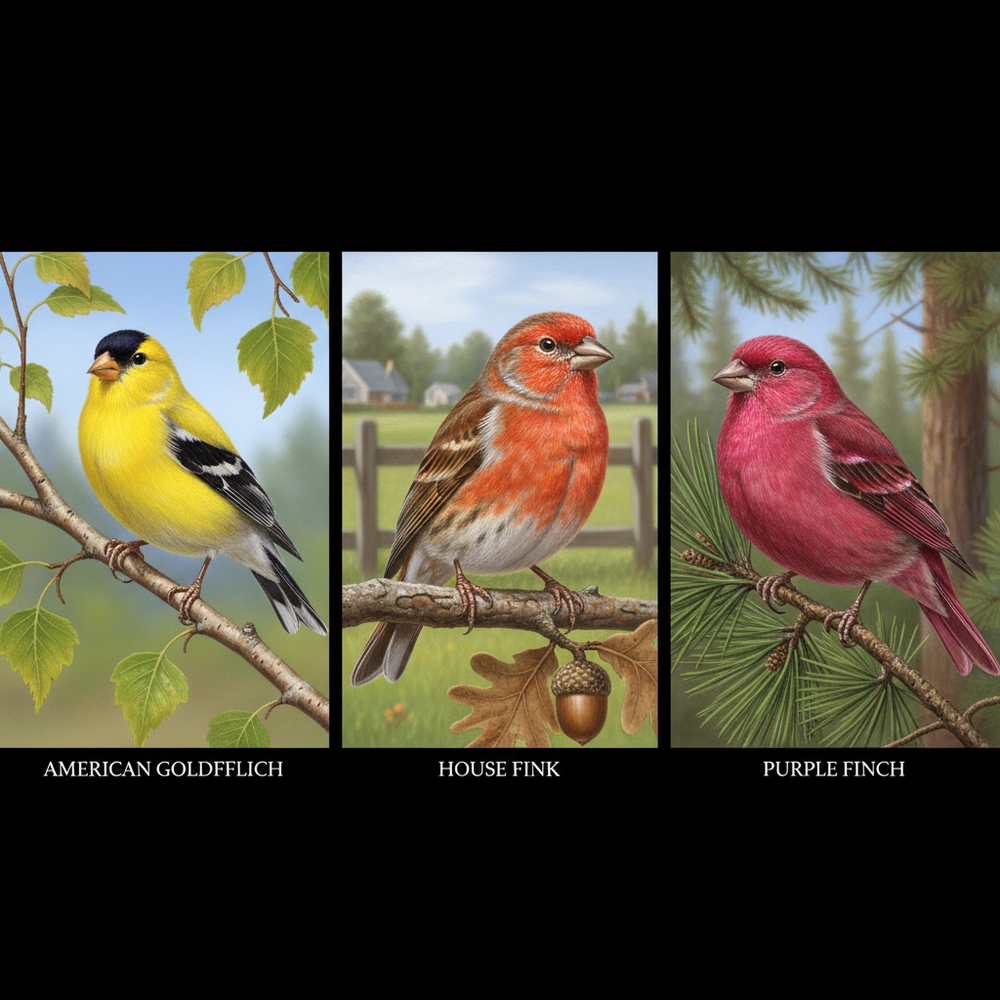
- The Look: Unmistakable. A brilliant, neon-yellow body with a stark black cap on the forehead, and black wings with white wing bars.
- The Behavior: Highly acrobatic. They will happily hang upside down on feeders or natural flower heads.
The Female and Non-Breeding Male (Winter)
This is where confusion starts. In the winter, the male Goldfinch sheds his bright yellow feathers and adopts the camouflage of the female.
- The Look: A dull, olive-yellow or grayish-brown body. The black cap disappears. However, they always retain the black wings with white wing bars. If you see a drab, small bird with black wings eating Nyjer seed, it is a Goldfinch in winter plumage.
2. The House Finch (The Year-Round Resident)
The House Finch is incredibly common across the entire United States. They are highly adaptable and will readily nest in hanging planters on your porch.
The Male House Finch
- The Look: A brownish bird with heavy brown streaking on the belly and flanks. The key feature is the reddish-orange or reddish-pink color on the head, upper breast, and rump.
- The Clue: The red on a House Finch looks like it was “painted on” over a brown bird. The coloring is often splotchy and concentrated on the front of the face and breast, not covering the whole head.
The Female House Finch
- The Look: A plain, grayish-brown bird with blurry, thick brown streaks entirely covering the breast and belly. They lack any red or yellow coloring. They have a relatively plain face without any strong eye stripes.
3. The Purple Finch (The Elusive Cousin)
The Purple Finch is less common than the House Finch and is often the subject of mistaken identity. They prefer more wooded areas and are primarily seen at feeders during winter irruptions or migration.
The Male Purple Finch
- The Look: Despite the name, they are not purple. They are a deep, rich raspberry red.
- The Clue: Unlike the splotchy red of the House Finch, the red on a Purple Finch looks like the entire bird was “dipped in raspberry juice.” The color washes smoothly over the entire head, back, and breast. They also have less streaking on the belly than the House Finch.
The Female Purple Finch
- The Look: Similar to the female House Finch (brown and streaky), but with a much more distinct face pattern.
- The Clue: Look for a bold, bright white stripe directly above the eye (a “supercilium”) and a dark brown patch on the cheek. Female House Finches have very plain, unmarked faces.
4. The Benefit of Binoculars
Trying to discern the subtle face stripe of a female Purple Finch from 40 feet away is impossible with the naked eye. To truly engage in bird identification, you need proper optics.
- The Tool: A pair of 8x42 binoculars is the standard for backyard birding, providing the light-gathering capability needed to see subtle color variations.
- Affiliate Pick: Nikon ProStaff 3S 8x42 Binoculars
Conclusion
Identifying finches takes a little practice, but once you know the “tells”—the black wings of the winter Goldfinch, the splotchy red of the House Finch, and the raspberry wash of the Purple Finch—you will see your feeding station with fresh eyes. Grab your binoculars, keep a field guide handy, and enjoy the diverse flock visiting your yard!