Published
- 5 min read
The Lesser Goldfinch: How to Spot the Western 'Green' Finch
The Lesser Goldfinch: How to Spot the Western ‘Green’ Finch
When most people think of a goldfinch, they picture the blinding, neon-yellow plumage of the male American Goldfinch. It is the classic “wild canary” of the eastern and midwestern United States. However, if you live in the western U.S., the Southwest, or Texas, you might notice that the “yellow” birds swarming your Nyjer feeder look a little different.
They are slightly smaller. They aren’t quite as blindingly yellow. In fact, many of them look downright green on their backs.
You aren’t looking at a mutated American Goldfinch or an escaped pet bird; you are looking at the Lesser Goldfinch (Spinus psaltria).
As a backyard birder, understanding the regional differences in bird populations is crucial for accurate identification. The Lesser Goldfinch is a fascinating, highly social, and vocal bird that dominates western feeding stations. In this guide, I will show you how to distinguish the Lesser Goldfinch from its American cousin, focusing on the key visual field marks and behavioral traits.
1. The Key Visual Differences: American vs. Lesser
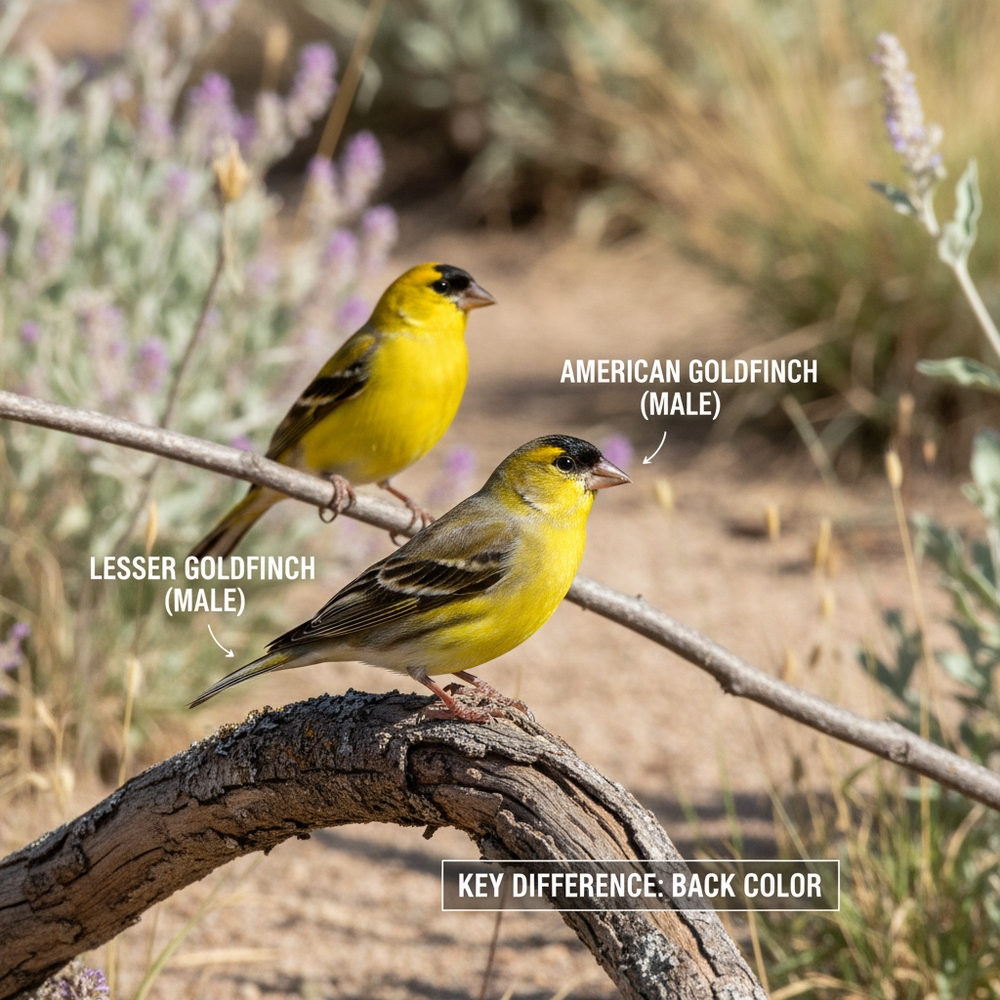
The most obvious difference between the two species is in the adult breeding males. While both have yellow underparts and black caps, the details tell the story.
The Male Lesser Goldfinch
- The Back: This is the dead giveaway. The back of a male Lesser Goldfinch is never yellow. Depending on the region, the back will either be a dull, olive-green (common on the West Coast) or a solid, glossy black (common in Texas and the Southwest).
- The Cap: The black cap on a Lesser Goldfinch extends further down the forehead and often connects to the dark coloring on the back.
- The Underparts: The yellow on the breast and belly is a true, bright yellow, but it often stops abruptly at the undertail coverts, which are white.
The Male American Goldfinch (For Comparison)
- The Back: A breeding male American Goldfinch is bright, lemon-yellow all over, including its back.
- The Cap: The black cap is small and sits precisely on the forehead, almost like a tiny visor.
2. The Tricky Identification: Females and Winter Plumage
Identifying the males in the summer is easy. Identifying the females, or the males in the winter, is where the real birding challenge begins.
The Female Lesser Goldfinch
Female Lesser Goldfinches are drabber than the males, lacking the black cap entirely.
- The Color: They are generally an olive-greenish color above and a dull yellow below.
- The Key Mark: Look at the undertail coverts (the feathers underneath the tail, just behind the legs). In female Lesser Goldfinches, these feathers are bright yellow. In female American Goldfinches, these feathers are white. This is the single most reliable way to tell them apart.
Winter Plumage Differences
Unlike the American Goldfinch, which undergoes a dramatic molt in the winter (turning from neon yellow to a dull, grayish-brown), the Lesser Goldfinch retains its basic color pattern year-round.
- If you see a small, greenish-yellow finch with white wing bars at your feeder in December, it is a Lesser Goldfinch.
3. Habitat and Feeding Preferences
Lesser Goldfinches are incredibly adaptable. They are found in dry chaparral, open woodlands, suburban backyards, and even deep desert scrub.
- The Feeder Preference: Like all goldfinches, they are strict granivores. They will swarm tube feeders filled with Nyjer seed and platform feeders filled with hulled sunflower chips.
- The Natural Diet: In the wild, they flock to weed patches. They are particularly fond of the seeds of the native sunflower (Helianthus), thistles, and the buds of cottonwood trees.
Creating a Lesser Goldfinch Sanctuary
If you live in the West, you can encourage Lesser Goldfinches to nest in your yard by leaving a patch of native “weeds” to go to seed in the late summer. They rely heavily on the soft plant down from thistles and cottonwoods to line their small, cup-shaped nests.
4. The Power of Optics for Subtle IDs
Trying to spot the difference between yellow and white undertail coverts on a tiny, fast-moving bird from 30 feet away is impossible with the naked eye. To confidently identify a Lesser Goldfinch, you need good binoculars.
- The Tool: A pair of 8x42 binoculars is the standard for backyard birding, providing the light-gathering capability needed to see subtle color variations in the shade of a tree.
- Affiliate Pick: Nikon ProStaff 3S 8x42 Binoculars
Conclusion
The Lesser Goldfinch is the cheerful, energetic soundtrack of the western backyard. By learning to look past the general “yellow” color and focusing on the olive-green or black backs of the males, and the yellow undertail coverts of the females, you can accurately identify these beautiful birds. Keep your Nyjer feeders full, grab your binoculars, and enjoy the unique charm of the West’s favorite finch!