Published
- 5 min read
Location is Everything: Where to Hang Your Finch Feeder for Maximum Traffic
Location is Everything: Where to Hang Your Finch Feeder for Maximum Traffic
You have done the research. You bought a premium polycarbonate Nyjer tube feeder, filled it with fresh, oily seed, and hung it proudly on your back patio. A week goes by, then two. Not a single yellow feather has appeared. You start to wonder if there are even any Goldfinches in your state.
The truth is, finches are likely flying over your house every single day. The problem isn’t the food, and it isn’t the feeder. The problem is the location.
Finches are small, highly cautious prey birds. They rely on specific environmental geometries to feel safe while eating. If your feeder is too exposed to hawks, too close to the ground, or hidden deep in the shadows of a porch, they will simply ignore it.
As a backyard birding expert, I will share the definitive “Rules of Placement” to ensure your feeding station acts as an irresistible, highly visible, and perfectly safe magnet for every finch in the neighborhood.
Rule 1: The “Flight Path” Visibility
Finches hunt by sight while flying high over the neighborhood canopy. If they cannot see the feeder from the sky, they won’t come down.
- The Mistake: Hanging a feeder deep inside a covered porch, under a dense awning, or buried in the low branches of a thick, weeping willow tree.
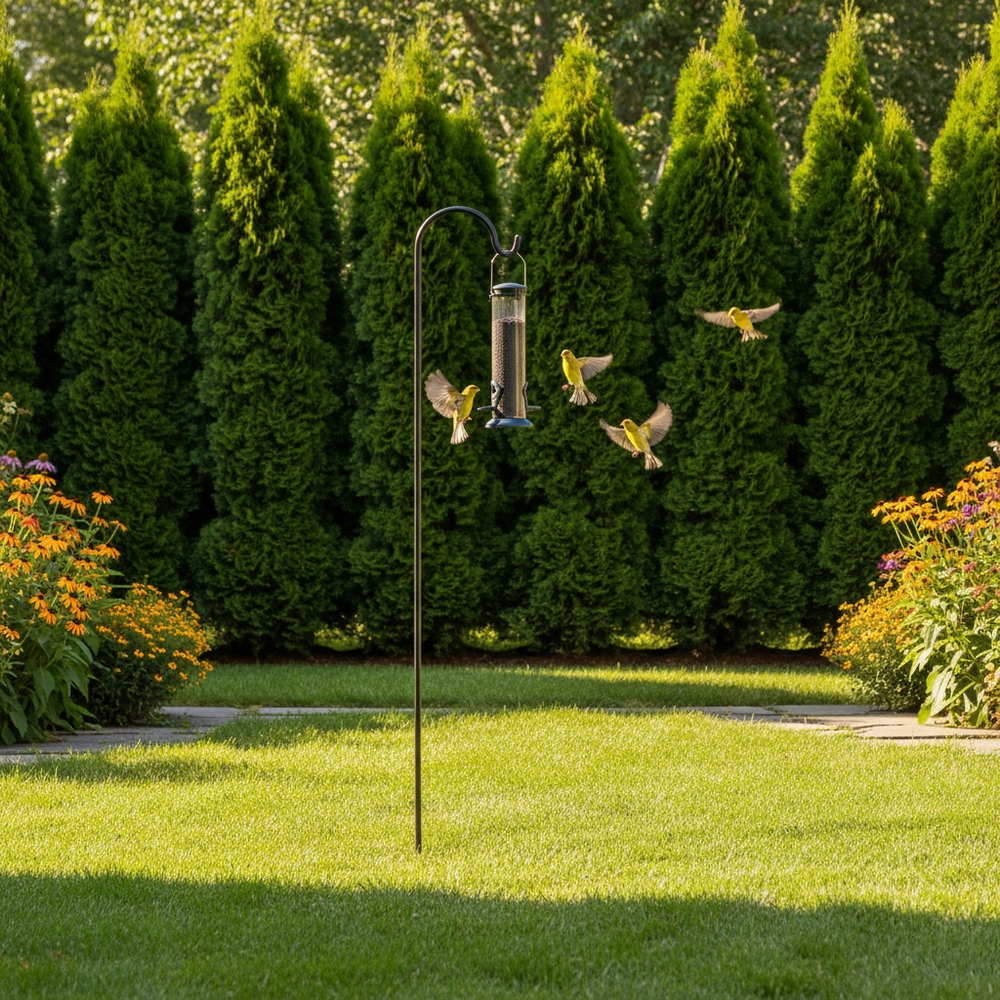
- The Fix: You must put the feeder out in the open. A standalone shepherd’s hook planted in the middle of the lawn or at the edge of a garden bed provides a clear line of sight for birds flying overhead.
- The “Yellow” Hack: Finches are attracted to the color yellow (just as hummingbirds love red). Tie a bright yellow ribbon around the pole, or plant bright yellow native flowers (like Black-Eyed Susans) directly below the feeder station to act as a visual runway light.
Rule 2: The “10-Foot Escape” Zone
While the feeder must be in the open, it cannot be in the middle of a barren, one-acre lawn. Finches are constantly scanning the sky for Sharp-shinned Hawks and Cooper’s Hawks. If a hawk dives, a finch needs immediate cover.
- The Rule: The feeder should be placed exactly 10 to 15 feet away from dense, brushy cover.
- Why it works: This distance is critical. It is far enough away that a neighborhood cat cannot hide in the bushes and leap out to ambush the feeding birds. However, it is close enough that if a hawk appears, the finches can dive into the thorny safety of a rosebush or an evergreen shrub in less than a second.
- The Ideal Cover: Juniper bushes, Holly bushes, or Arborvitae provide dense, year-round safety networks.
Rule 3: The “Window Strike” Danger Zone
One of the most common places people want to hang a feeder is right outside their massive living room picture window.
As discussed in our safety guides, this is highly dangerous due to the “reflection illusion.” If a hawk spooks the flock, the finches will scatter blindly. If the window reflects the sky, they will fly straight into the glass at top speed.
- The Placement Rule: A feeder must be closer than 3 feet to a window (so they cannot build up enough speed to hurt themselves if they hit it) or further than 30 feet away (giving them ample time to recognize the house as an obstacle and steer clear).
- The Compromise: If you must place it 15 feet from a window, you are required to cover the outside of that glass with heavy-density UV-reflective decals to break up the reflection.
Rule 4: Segregation from the “Bully Birds”
If you are trying to attract finches, you are likely also feeding Cardinals, Jays, and Woodpeckers at a different station.
- The Mistake: Hanging your delicate Nyjer tube feeder on the exact same pole as a massive hopper feeder filled with cheap mixed seed and cracked corn.
- The Problem: The mixed seed will attract loud, aggressive, swarming birds like Grackles, Starlings, and House Sparrows. The delicate Goldfinches will be too intimidated by the chaos to approach the pole.
- The Fix: Create a dedicated “Finch Hub.” Place your Nyjer feeders and upside-down thistle feeders on a completely separate pole system, at least 20 feet away from your main mixed-seed feeding station.
Conclusion
Hanging a bird feeder is an exercise in real estate. By placing your standalone pole out in the open for aerial visibility, maintaining a strict 10-foot distance from protective brush, and segregating the delicate finches from the loud neighborhood bully birds, you create the perfect psychological environment. When a finch feels safe, it stays longer, eats more, and brings its friends. Move your pole today, and watch the flock arrive!